REAL-TIME MONITORING
CCTV AI cameras, GPS trackers, RFID gantries, ultrasonic sensors, and smart traffic lights continuously report conditions.
AI & IoT-Based Intelligent Transportation System
Designing a scalable AWS cloud architecture for real-time traffic monitoring, AI-powered incident detection, congestion prediction, smart signal optimization, and emergency vehicle prioritization.
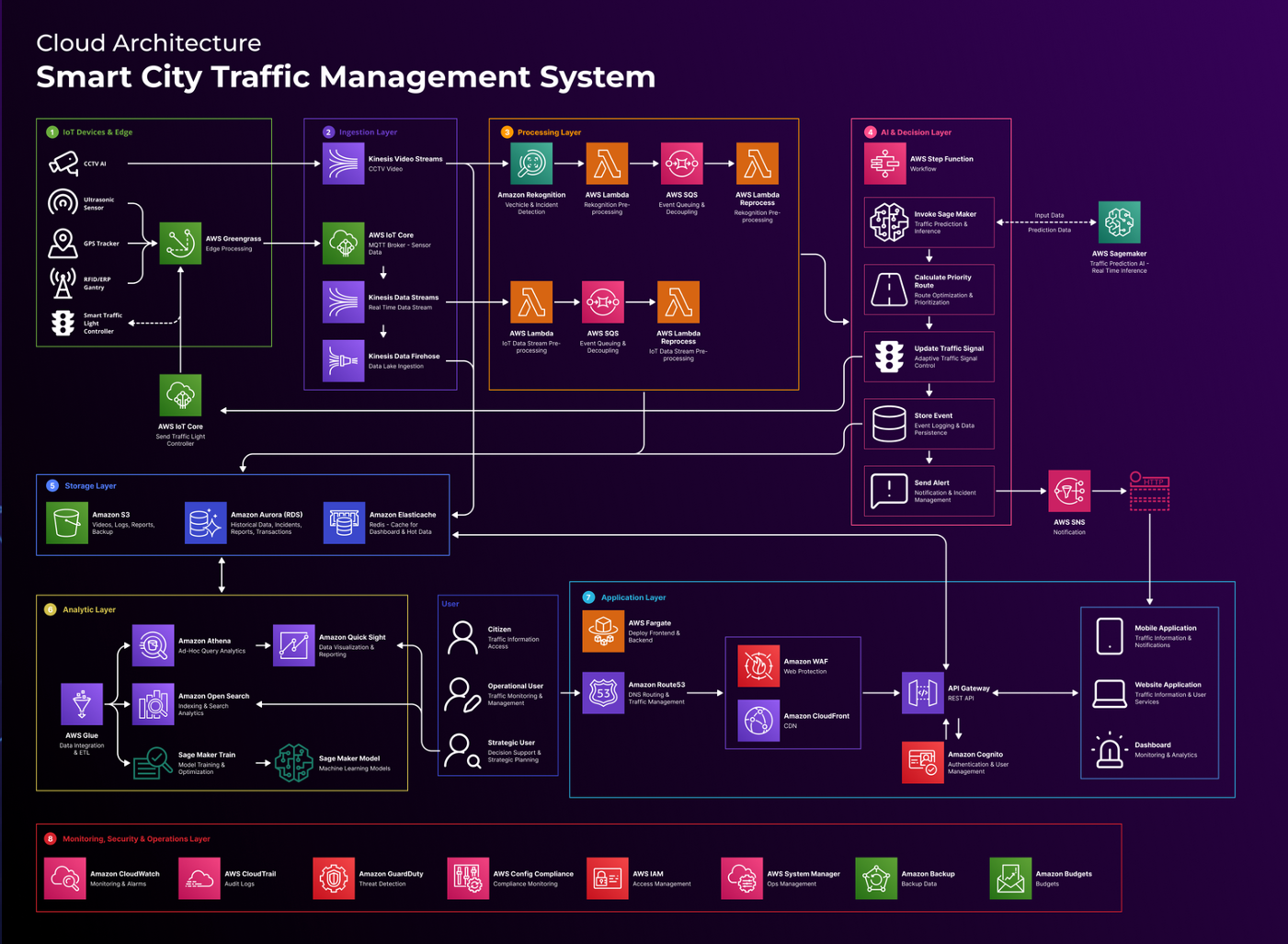
The architecture connects field devices, realtime streams, AI decisioning, analytics, applications, and security into one city-scale system.
CCTV AI cameras, GPS trackers, RFID gantries, ultrasonic sensors, and smart traffic lights continuously report conditions.
Computer vision and AI-powered video analytics identify incidents from live traffic feeds.
Historical and realtime data support congestion and traffic-pattern analysis.
Traffic signals can respond dynamically to current conditions.
Ambulances, fire trucks, and police vehicles can receive green-wave coordination.
Longer travel times and reduced transportation efficiency.
Emergency vehicles can be delayed without coordination.
Fixed schedules cannot react to current traffic.
Traffic data arrives from many device types.
Continuous camera and sensor streams must be absorbed.
Public infrastructure requires strong access control and detection.
Continuously collect and monitor traffic conditions.
Detect vehicles and incidents from live traffic data.
Optimize signals and routing from current conditions.
Prioritize emergency vehicles through intelligent routing.
The architecture separates collection, transport, intelligence, persistence, delivery, and operations so each workload can scale and fail independently.
Collects real-time traffic data from cameras, trackers, gantries, sensors, and controllers.
Receives and streams edge data into AWS for realtime processing.
Detects incidents, predicts congestion, and drives automated decisions.
Separates real-time state, transactional records, and historical traffic data.
Generates analytical queries, dashboards, alerts, and operational insights.
Delivers traffic information and operations tools to users and operators.
Treats public-infrastructure security and observability as first-class concerns.
The architecture separates realtime ingestion, processing, storage, analytics, application delivery, and operational security into dedicated layers.
CCTV, GPS, RFID, ultrasonic sensors, and controllers generate realtime data.
Greengrass aggregates devices and enables low-latency local execution.
IoT Core handles MQTT communication while Kinesis handles streams.
Lambda and SQS absorb workloads and decouple traffic spikes.
Rekognition analyzes video and SageMaker provides inference.
Step Functions orchestrates the workflow and IoT Core sends commands back.
Kinesis absorbs streams, SQS buffers spikes, Lambda processes events, and Firehose delivers them into storage.
Rekognition performs detection, Step Functions orchestrates the decision workflow, SageMaker provides inference, and IoT Core sends the resulting command back to edge infrastructure.
CCTV → Kinesis Video Streams → Rekognition → Incident → Step Functions → SageMaker → Route priority → Signal update.
The system detects an incident, evaluates its impact, and coordinates traffic response.GPS Tracker → IoT Core → Traffic priority calculation → Green Wave → Smart Traffic Controller.
Emergency vehicles receive traffic signal priority to reduce response time.High-throughput realtime ingestion for continuous traffic streams.
Asynchronous buffering and decoupling between processing components.
Scalable data lake and long-term archive for historical workloads.
Consistent structured storage for transactional traffic data.
Hot traffic state and low-latency reads without repeated database load.
Computer vision for vehicle and incident detection from video.
Inference and a path toward future model retraining.
Orchestration for multi-step AI decision workflows.
Secure device communication and command routing back to the edge.
Managed REST entry point for applications and dashboards.
Fast application delivery with a protected public perimeter.
Authentication and user management for application access.
Realtime traffic state and frequently accessed information.
Structured information requiring consistency.
Historical logs, video archives, and analytical data.
Separating hot, transactional, and analytical workloads prevents a single database from becoming a bottleneck.
Historical traffic data is retained in S3, catalogued by Glue, queried through Athena, and visualized in QuickSight. The same archive can support future model retraining.
Because the system manages public infrastructure, security and operational observability are treated as first-class architectural concerns.
Kinesis handles continuous high-throughput streams.
SQS absorbs traffic spikes.
Lambda scales event-driven workloads.
Greengrass reduces latency and network dependency.
ElastiCache reduces repeated database reads.
CloudFront distributes application content.
S3 provides scalable long-term storage.
Thousands of CCTV frames and sensor events can arrive continuously.
SOLUTIONKinesis + SQS + FirehoseTraffic incidents require fast decisions and command routing.
SOLUTIONKinesis Video Streams + Rekognition + Step Functions + SageMaker + IoT CoreTraffic information may be accessed simultaneously by many users.
SOLUTIONElastiCache + CloudFront + API GatewayHistorical data must remain useful for analytics and model improvement.
SOLUTIONS3 + Glue + Athena + QuickSight + SageMakerA public platform needs strong perimeter, identity, audit, and detection controls.
SOLUTIONWAF + Cognito + GuardDuty + CloudTrail + CloudWatchAWS Pricing Calculator estimate; excludes applicable taxes and represents projected workload cost rather than actual billing.
Potential savings identified in the architecture analysis: investigate Rekognition Provisioned Throughput and SageMaker Reserved Instances as cost-optimization strategies.
Potential AI/ML savings estimate: 30–40% · recommendation, not a guarantee.The architecture prioritizes realtime responsiveness for traffic-critical workloads while separating long-term analytics from latency-sensitive operations.
Streaming and event-based processing for realtime traffic data.
SQS and modular services prevent cascading failures.
Managed and serverless services support elastic workloads.
Edge processing, caching, and realtime streaming.
Transactional, hot, and analytical workloads stay separate.
Authentication, detection, monitoring, and auditing are integrated.
Designed a city-scale AWS cloud architecture that connects IoT infrastructure, realtime streaming, AI inference, automated traffic decisions, analytics, application delivery, and security into one integrated system.